

The Deeper Read: S2E5 - The Binding of Isaac
The Knife, the Boy, and the Producer’s Cut

In every great drama, someone has to bleed.
Last week, Sodom burned, Lot’s wife froze, and Abraham negotiated with God like a producer trying to save a doomed series.
This week? The bill comes due. And before the smoke even clears from the last plot twist, the Bible throws us right back into one of Abraham’s favorite storylines: The “She’s-My-Sister” Cinematic Universe.
Like a bad pitch for a subplot in Chinatown, Abraham rolls out the “My sister! My wife!” routine with zero sense of irony.
Because yes—he does it again. Like a wacky sitcom callback nobody asked for.
Missed the previous assignment? No problem.
Last week, we tackled Genesis 20–22:
Where Abraham runs the same con twice,
God drops a miraculous pregnancy reveal,
and Isaac’s near-sacrifice lands like a season-finale shocker.
Catch up here: Genesis 20 - 22 (NIV)
The Recycled Plotline
(Genesis 20)
Sarah has been handed off more times than a prop baby in a sitcom. First she was given to Pharaoh. Now she’s scooped up by a king.
Enter: Abimelek, King of Gerar—pulled into Abraham’s family drama like an unsuspecting guest star who didn’t read the script before signing on.
Abimelek takes Sarah into his household. He is innocent. He has no idea he just walked into a con.
So God appears to him in a dream and basically says: “You’re a dead man.”
A truly divine bedside manner.
Listen to the audio podcast episode here.
Abimelek, understandably alarmed, replies: “What? I didn’t even touch her!”
And God suddenly softens: “Yeah, I know. Good thing I didn’t kill you… yet.”
The vibe is bizarre—like someone pretending to be God. Overplaying the authority. Overshooting the intimidation. Forgetting to read the room.
But Abimelek pushes back, and God essentially goes:
“Okay, okay, you’re right. You’re innocent. Now return the woman… and compensate the guy who lied to you.”
It’s wild: God threatens the wrong guy. Then admits the wrong guy is right. Then orders the wrong guy to pay the man who deceived him.
It reads like Abraham and the Lord functioning as a tag-team hustle. A two-man grift. A traveling con act running the same “my beautiful sister” scam on every kingdom from here to Egypt.
And then comes Abraham’s explanation—either the world’s weirdest lie or a sudden family-tree jump scare: “She’s actually my sister.”
Half-sister, allegedly. Or maybe that’s a retroactive justification. Or maybe he’s doubling down on the scam.
The text gives no clarity because the text is apparently in on the trick, but we’re not. And here’s the uncanny part: Abimelek believes him.
Like Lot’s wife turning to look. Like Pharaoh caving for no reason. Like every king who encounters Abraham and immediately folds.
It feels like a spell cast on the scene—not overtly stated, but narratively enforced.
Abraham lies. God threatens. The king pays. Sarah floats between households like a pawn—or like a pawn that’s reached the last row and is about to become a queen.
This isn’t faith behavior. This is franchise behavior.
Sarah’s Rise to Power
(Genesis 21:1–21)
And then—finally—the miracle baby arrives. Isaac, the long-awaited heir. The golden child. The narrative justification for the Sarah–Hagar rivalry.
The birth scene is surprisingly gentle. Sarah laughs again—not in disbelief this time, but in triumph. A callback rewritten with God’s blessing.
And then immediately—IMMEDIATELY—conflict returns. Sarah sees Ishmael “laughing,” or “mocking,” or “playing,” depending on the translation. Whatever he’s doing, she hates it.
And in a moment so casually cruel it barely registers in Sunday School, she says to Abraham: “Cast out the slave woman and her son.”
Not Hagar. Not Ishmael. Just: the slave woman. Her son.
Sarah unloads her rage on the woman Abraham slept with to fulfill his end of the covenant, a situation she engineered but later regretted. Ishmael—a boy coerced into existence—becomes collateral damage.
Abraham? He’s heartbroken. The only moment in the entire Abraham narrative where he expresses tenderness is here, pleading for his son.
God? God sides with Sarah. Again.
“Do whatever she tells you.”
This is astonishing.
Sarah overrides the patriarch. She dictates another woman’s fate. She determines the trajectory of a bloodline. This isn’t domestic hierarchy. This is divine favoritism.
And yet—in a twist that feels like God hedging His bets—an angel appears to Hagar in the wilderness and says: “I will make a great nation of him also.”
So: God sides with Sarah. God sides with Hagar. Isaac is the heir. Ishmael is the backup plan.
It’s double-dealing. Political maneuvering. This isn’t faith—it’s chess.
And Abraham is losing control of the board.
Sidebar: The Woman Who Lied to God
Before you feel too shocked that God backs her again, remember: Sarah already lied to God’s face and got away with it.
No punishment, no consequences, no moral lecture—just blessings. God asked her directly, “Why did you laugh?” and she flat-out said, “I did not laugh,” even though we know she laughed, God knows she laughed, and the narrator goes out of their way to tell us she laughed.
She denies a truth God Himself witnessed—and nothing happens.
It’s almost as if Sarah has narrative immunity. She’s protected. Her word reshapes the story. She is, in a structural sense, the true power behind the covenant machinery.
And it forces a question: what exactly is the arrangement between Sarah and God? What are the terms of their agreement? And will we ever know?
The Land Deal and the Weird War Interlude
(Genesis 21:22–34)
Just when you think we’re done, we get a sudden geopolitical side quest:
A military alliance. A border dispute. King Abimelek again (poor guy). And a covenant about water rights.
It’s real estate law dressed up as scripture. Because at the end of the day, Genesis keeps steering us back to the same cosmic punchline:
Land, land, land. Territory, covenant, inheritance. The knife and the promise always lead back to the map.
It’s the spine beneath every subplot.
The Knife
(Genesis 22)
And now we reach the sweeps-week cliffhanger. The Emmy reel. The scene that launched three religions and a thousand interpretations:
The Binding of Isaac.
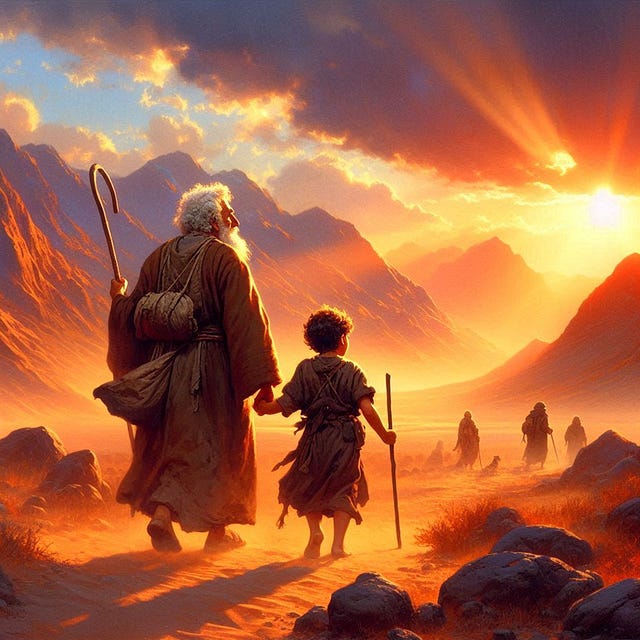
God calls to Abraham. Abraham answers immediately, like a man trained to fear silence. God gives him instructions that read like a hazing ritual:
“Take your son, your only son, the one you love…”
As if God is emotionally priming the moment. As if God is savoring the specificity.
“…and sacrifice him as a burnt offering on a mountain I will show you.”
Not our son. Not the heir I promised you. Not the boy you waited one hundred years for.
Your son. Your only son. The one you love. Burn his body. Offer it to me.
It’s intimate. It’s personal. It’s manipulative.
And Abraham goes. No protest. No negotiation. No “But what about the promise?” No “Take me instead.”
Just silent obedience from a man who argued for strangers in Sodom but won’t argue for his own child. Abraham spent last episode proving to God—and to us—that he can negotiate. He knows how to bargain. It’s actually kind of his thing.
He knows how to push back. He knows how to save a doomed city, or at least how to try to. But he doesn’t even try to save Isaac.
Why? Because the con has flipped. This is the first time it feels like Abraham isn’t running the game—it seems as if he’s the one being played.
The Boy Carries the Wood
Isaac gets one line in the entire scene: “Where is the lamb?”
He’s carrying the wood for his own sacrifice. Abraham is carrying the knife. The roles are symbolic. The silence is deafening.
And Abraham lies to his son: “God will provide.”
It’s the same tone he used with Abimelek. The same evasive logic he used with Pharaoh. The same vagueness he uses with Sarah.
He lies because he feels he has to. He lies because he’s afraid. He lies because he doesn’t know how to get out of this.
Abraham isn’t the con man anymore—he’s the mark.
The Angel in the Edit Bay
Knife raised. Camera tight. Breath held. And then—with the timing of a perfectly directed thriller—an angel calls out: “Do not lay a hand on the boy.”
Cue the ram. Was the ram always there? Did it spawn in after the rewrite? Is this divine providence or post-production? The text doesn’t say.
But the effect is clear: Abraham is humiliated, broken, and pliable. Isaac is traumatized into silence. And God reasserts total control of the narrative.
The patriarch has been tamed. The family has been broken.
The Two Sons Gambit
Here’s the part nobody teaches in Sunday School: Isaac wasn’t spared because he “proved” anything. He wasn’t spared because Abraham passed the test. He wasn’t spared because of obedience, loyalty, devotion, faithfulness, or any of the comforting reasons preachers like to recycle.
Isaac was spared for the same reason Ishmael was spared in the wilderness:
The story needs both boys alive.
In Genesis, the moment a child becomes inconvenient, God solves the problem in one of two ways: miracle, or near-death intervention.
But Isaac and Ishmael? Both get rescued. Both get promises. Both get future nations. Not because of sentimentality. Because of strategy.
If Isaac dies on the mountain, the covenant collapses. If Ishmael dies under the desert bush, the rivalry collapses.
The engine of the Abrahamic story isn’t obedience. It’s dual inheritance.
Two sons. Two promises. Two bloodlines. Two nations destined to become two worlds.
Isaac is spared not as a reward, but as a setup. A narrative maneuver. A long-game move.
The mountain scene isn’t the end of Abraham’s test—it’s the beginning of a geopolitical split that will ripple into Judaism, Christianity, Islam, and the modern world.
God doesn’t stop the knife because Abraham earned mercy. God stops the knife because the script requires: A chosen son and a shadow son, both alive, both marked, both believing they’re the rightful heir.
This isn’t mercy. This is world-building. This is very high-level chess.
The boys are no longer just sons. They are Houses. They are kingdoms. They are ideological franchises intentionally destined to collide.
And Abraham? He’s not just a patriarch anymore. He’s suddenly the father of a divine rivalry—architect of the most consequential sibling split in human history.
It’s not about testing faith. It’s about positioning the players.
And somewhere offstage, a third storyline is already forming—the wild card that turns a two-house rivalry into a three-way fracture so deep that peace becomes mathematically impossible.
The Contract, Renewed
Isaac survives. The knife falls on a ram instead of the young man. But something unspoken dies on that mountain:
Abraham’s autonomy. Isaac’s innocence. The illusion of mutual trust.
And then, just to remind you what this was all really about, the episode closes with blessings about nations, descendants, borders, and land.
Because the covenant isn’t emotional. The covenant isn’t moral. The covenant isn’t personal. It’s territorial. It’s a franchise contract written in flesh and fear.
Next week: The consequences of this mountain—and the fractures it leaves in Abraham’s family—begin to ripple outward.
This Week’s Reading: Genesis 23–24
Sarah dies. Isaac disappears from the narrative for a while. And Abraham goes looking for the next woman to carry the contract.
It’s just one episode of many in the longest running soap opera of all time, and we’re still just in Genesis.
Why this version?
We’re continuing with the NIV (New International Version) because it strikes the right balance: clear, accessible, and still strange enough to let the text speak for itself.
Thanks for joining me on The Deeper Read.
If you like where this is going, subscribe to Lisa Writes Now on Substack—that’s where you’ll find full transcripts, bonus content, and deeper receipts.
And if you’re ready to go further down the rabbit hole...
Season 3 of The Hidden Cut is already in the works, picking up right where Season 2 leaves off.
Keep your questions holy, your thinking heretical and your inbox spicy.
🎬 Continue the Series
← Previous Episode: Negotiating With God
→ Next Episode: The Heir Apparent
📂 Full Episode Guide: Cold Open
Subscribe to Lisa Writes Now on Substack for fresh cuts, hot takes, and all my latest writing mischief.
Think something g ot left on the cutting room floor?
Add your notes below—we’re still editing in real time.